- Skills Scoop
- Posts
- The conferences to attend in 2026 + 5 predictions for the credential ecosystem
The conferences to attend in 2026 + 5 predictions for the credential ecosystem
In partnership with

✅ Inside this issue:
Robert shares his 5 predictions for the credential ecosystem
The 2026 conferences to put on your radar
The NY Times video on skills you gotta watch this weekend
INTERESTING READS
🧭 Accountability starts at the top if leaders want it from their teams.
🤖 Even execs are behind, see where senior leaders struggle with AI adoption.
🎓 Skills-based hiring is rising, but students still don’t get it.
📊 Not all credentials deliver, but these ones actually help workers.
TRENDS

5 shifts coming to the credential ecosystem in 2026
For more than a decade, I’ve watched the credential ecosystem evolve through a period defined largely by experimentation. Digital badges proliferated, micro-credentials expanded across institutions, and new frameworks emerged to help structure and organize them. Innovation became the organizing principle of the field, and experimentation was widely encouraged.
I believe that era is beginning to close.
Not because innovation failed, but because innovation without infrastructure has reached its limits.
The United States now has nearly 1.85 million unique credentials, including more than one million digital badges. From my perspective, the ecosystem no longer lacks credentials. Instead, it suffers from a lack of clarity about which ones actually matter (and why).
As the number of credentials continues to grow, the central challenge facing the field is shifting. The question is no longer simply how to create new credentials, but whether those credentials can be trusted, understood, and used across systems.
Here are five shifts I expect to shape the credential ecosystem in 2026.
The innovation era is ending
For years, the ecosystem rewarded experimentation. I watched institutions create new credentials, platforms launch new formats, and pilots test new ways to recognize skills. But with nearly 2 million credentials already in circulation, the problem is no longer one of scarcity.
It’s a signal.
I’m increasingly seeing funders, policymakers, and institutions shift their attention toward the infrastructure that allows credentials to function at scale.
For example, the Every Student Succeeds Act spurred the adoption of micro-credentials in K-12 education as schools sought to demonstrate compliance with new accountability measures.
Similarly, the Workforce Innovation and Opportunity Act encouraged employers and training providers to explore alternative certifications as a way to meet evolving workforce needs and access federal funds.
That includes verification systems, metadata transparency, interoperability layers, and mechanisms for tracking outcomes.
In this environment, the most important question will not be “What credential should we design next?” but rather “Can this credential be trusted across systems?”
The most important question will not be
“What credential should we design next?”
but rather
“Can this credential be trusted across systems?”
Credentials move from creation to evaluation
I also believe the labor market is beginning to exert greater pressure on the ecosystem.
Research consistently shows that credential value follows a familiar pattern: a relatively small share leads to meaningful wage gains, while many provide limited economic return.
During the experimentation phase, this imbalance was largely tolerated. As the number of credentials grows, that tolerance is fading.
Employers, policymakers, and funders are asking harder questions about outcomes, earnings transparency, and labor market signals. Credentials that cannot demonstrate clear value are unlikely to disappear overnight, but they will gradually lose relevance as stronger signals emerge.
In other words, I believe the ecosystem is moving from credential creation to credential evaluation.
Open Standards become procurement requirements
For years, debates about open architecture often sounded philosophical.
Today, I’m seeing those debates turn into very practical procurement decisions.
Governments and large institutions are becoming increasingly unwilling to adopt systems that create vendor lock-in or rely on proprietary data formats. Instead, they are gravitating toward open standards that allow credentials to move across systems and platforms.
Standards such as Open Badges (OB), Verifiable Credentials (VC), Learning and Employment Records (LERs), and the Credential Transparency Description Language (CTDL) are gaining traction because they enable interoperability.
In my view, open systems are not winning because they are ideologically appealing, but because they scale.
Policy moves from encouragement to accountability
Earlier waves of policy largely encouraged experimentation. Legislation and funding programs supported pilots, innovation grants, and new credential models. That exploratory phase played an important role in expanding the ecosystem.
But I expect the next phase to look different.
Procurement requirements, funding structures, and reporting standards are gradually shifting toward measurable outcomes, transparency, and interoperable infrastructure. Policymakers are no longer asking simply whether innovation is happening. They are asking whether the systems being built actually deliver value.
The policy conversation, as I see it, is moving from encouraging innovation to ensuring accountability.
Curators replace creators
Perhaps the most important shift involves who holds influence in the ecosystem.
For much of the past decade, the system rewarded creators: institutions building credentials, platforms issuing badges, and innovators launching pilots.
In the next phase, I believe influence will increasingly shift toward curators.
These are the organizations capable of validating credentials, comparing their value, establishing standards, and connecting fragmented systems. As the ecosystem matures, the ability to organize and interpret credentials may become more valuable than the ability to create them.
The ecosystem is maturing
Let’s be clear, I don’t believe the credential ecosystem is abandoning innovation.
It’s maturing.
Complex systems often evolve through a predictable pattern: variation, evaluation, standardization, and reliability. For more than a decade, the credential field has been in the variation stage.
I believe the next phase will focus on evaluation.
The organizations that succeed will not be those creating the most credentials. They will be the ones to build the trust, transparency, interoperability, and measurement systems that enable credentials to function as durable signals in the labor market.
The experimental era expanded the ecosystem. The infrastructure era will determine whether it becomes durable.
 | Robert Bajor |
TOOLS

HR, payroll, and benefits… but make it easy
I’ve used a lot of tools over the years, but Gusto is one that stuck with me.
Back in my corporate days at Scoot Education, when we were a team of 2 at a startup, we needed something simple. By the time we scaled to 70 people, we needed something that could actually keep up.
Gusto handled both.
From the employee side, I still remember the payday emails with confetti that said “Hoorah! You got paid! 🥳” Simple, but it made the experience feel thoughtful and human… and here I am 5+ years later still talking about it!
From the leadership side, it was a no-brainer:
Setting up new employees took minutes
Payroll, benefits, and HR lived in one place
We didn’t need a massive HR team just to stay organized
It let us stay lean and focus on what actually mattered: building the business.
Today, 400,000+ small and medium-sized businesses use Gusto to:
✔ Run payroll without the headache
✔ Manage benefits and compliance in one place
✔ Onboard new hires quickly and cleanly
If you’re scaling a team and don’t want HR to slow you down, this is a solid place to start. Highly recommend it!
 | Thania Guardino |
EVENTS

The conferences to attend in 2026
Whether you’re designing policy, building tech, leading HR, or rethinking education pathways, one thing’s clear: 2026 is packed with conferences you’ll actually want to attend.
These are the rooms where the future of work, learning, and credentials gets debated, demoed, and decided—often by the same people building it.
We’ve rounded up the ones worth your time—from skills-based hiring and LER infrastructure to AI-powered workforce strategy and credential innovation.
SPRING 2026
ASU+GSV Summit 📍San Diego, CA | 📅 April 12–15, 2026
💰 Registration: $2800-$4400+
Who should go: EdTech founders, investors, policy folks, and anyone betting on the future of learning + work.
Why it matters: This is the “big tent” of the ecosystem—7,000+ people across education, workforce, and tech. If you want to understand where skills, AI, and credentialing are heading at a macro level, this is where the conversations start.
SHRM Talent Conference & Expo 📍 Dallas, TX | 📅 April 19–22, 2026
💰 Registration: ~$1,495+
Who should go: Talent acquisition leaders and HR teams trying to modernize hiring.
Why it matters: This is where skills-based hiring starts to become real inside organizations—not just a talking point.
Workhuman Live 📍 Orlando, FL | 📅 April 27–30, 2026
💰 Registration: ~$1,500–$2,500
Who should go: HR leaders focused on culture, engagement, and employee experience.
Why it matters: A strong reminder that the future of work isn’t just systems and skills—it’s people, recognition, and how work actually feels.
ATD 2026 International Conference & Expo 📍 Los Angeles, CA | 📅 May 17–20, 2026
💰 Registration: ~$1,595+
Who should go: L&D leaders, talent development teams, and skills strategists.
Why it matters: Where upskilling, AI in learning, and performance strategy come together in a very real way.
NAWDP Annual Conference 📍 Phoenix, AZ | 📅 May 18–20, 2026
💰 Registration: ~$400–$600
Who should go: Workforce boards, nonprofits, community colleges, and policy implementers.
Why it matters: This is where workforce strategy gets tested in the real world—programs, funding, and impact.
NACE26 Conference + Expo 📍 Denver, CO | 📅 June 9–11, 2026
💰 Registration: ~$1,299+
Who should go: Career services leaders and early talent recruiters.
Why it matters: If you care about early talent pipelines, this is one of the most important rooms you can be in.
SHRM Annual Conference & Expo 📍 Orlando, FL | 📅 June 16–19, 2026
💰 Registration: ~$2,295+
Who should go: HR leaders across every function.
Why it matters: This is where trends hit scale. If something matters to HR, it shows up here.
SUMMER
Badge Summit 2026 📍 Boulder, CO | 📅 July 13–15, 2026 (+ Virtual Aug 4)
💰 Registration: $339-$449
Who should go: LER builders, credential issuers, and ecosystem leaders.
Why it matters: One of the most hands-on communities in the space—real builders, real use cases.
JFF Horizons 2026 📍 Washington, D.C. | 📅 July 13–15, 2026
💰 Registration: ~$1,350+
Who should go: Policy leaders, philanthropies, workforce orgs, and system builders.
Why it matters: Where policy, funding, and workforce strategy collide in a meaningful way.
1EdTech Learning Impact Conference 📍 San Francisco, CA | 📅 June 1–3, 2026
💰 Registration: $1150-$1450
Who should go: Education leaders, edtech builders, IT and academic tech teams, and anyone working on digital credentials, data standards, or interoperability.
Why it matters: This is where the systems behind modern learning actually come together. From AI and digital credentials to data standards and interoperability, the focus is on building technology that works across institutions and ecosystems. If you care about how skills, credentials, and learning data move in the real world, this is one rooms you want to be in.
FALL
Future of Work USA 📍 Dallas, TX | 📅 September 14–15, 2026
💰 Registration: $700+
Who should go: HR, L&D, and transformation leaders.
Why it matters: Focused on how organizations actually implement change—not just talk about it.
Convergence: Credential Innovation in Higher Education 📍 Washington, D.C. | 📅 October 13–15, 2026
💰 Registration: $995-$2400
Who should go: Higher ed leaders building credential strategy.
Why it matters: One of the most important convenings for rethinking how institutions evolve.
HR Technology Conference📍 Las Vegas, NV | 📅 October 20–22, 2026
💰 Registration: ~$1,800+
Who should go: HR tech buyers, operators, and vendors.
Why it matters: If you want to understand the tools shaping hiring and workforce strategy, this is the floor to walk.
If there's an upcoming conference we missed, please reply to this email and let us know!
COMMUNICATIONS
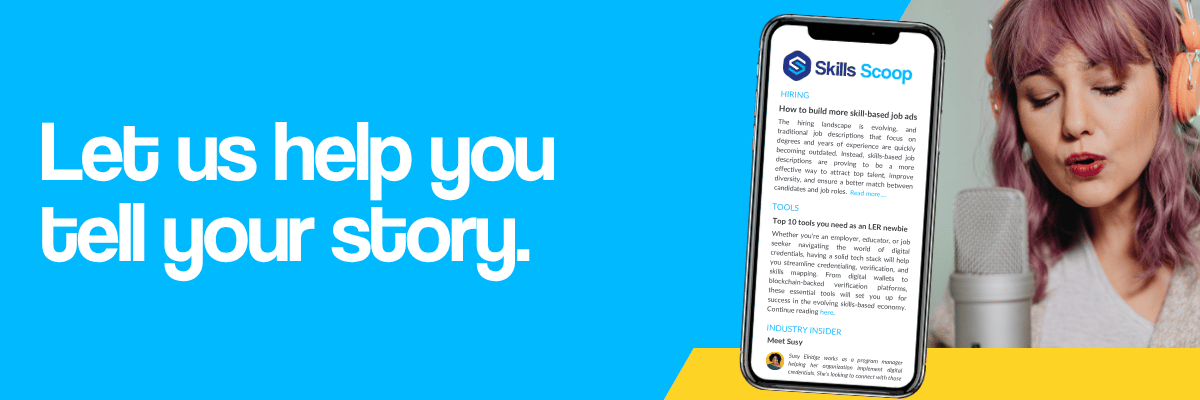
Stop wasting time marketing to the wrong audience
Launching a pilot? Publishing a whitepaper? Rolling out new technology?
And still hearing… crickets?
It’s not always the program or product.
It’s often the audience or the way it’s being explained to them.
The reality is that Learning and Employment Records, and digital credentials are still complex and confusing for many stakeholders. If your messaging is unclear or landing in front of the wrong people, it doesn’t matter how strong your work is.
That’s where we, SkillsScoop, come in.
We reach the people already shaping the skills-based ecosystem. HR leaders, workforce development executives, higher education administrators, funders, and policymakers who are actively trying to understand what’s working and what comes next. We also know how to reach the general public to explain and educate your offering to them.
Instead of shouting into the void, you can:
✔ Get in front of the right audience already engaged in LERs and skills-based hiring
✔ Translate complex work into clear, compelling storytelling that actually resonates
✔ Position your pilot, product, or research within the broader ecosystem
Whether you’ve just secured funding, launched something new, or are trying to get the right partners to pay attention, we help your work land with the people who matter.
✨Stop wasting cycles on the wrong messaging. Start showing up in the right rooms. Consider advertising with us. Or let’s talk about our consulting and communications packages.
BY THE NUMBERS
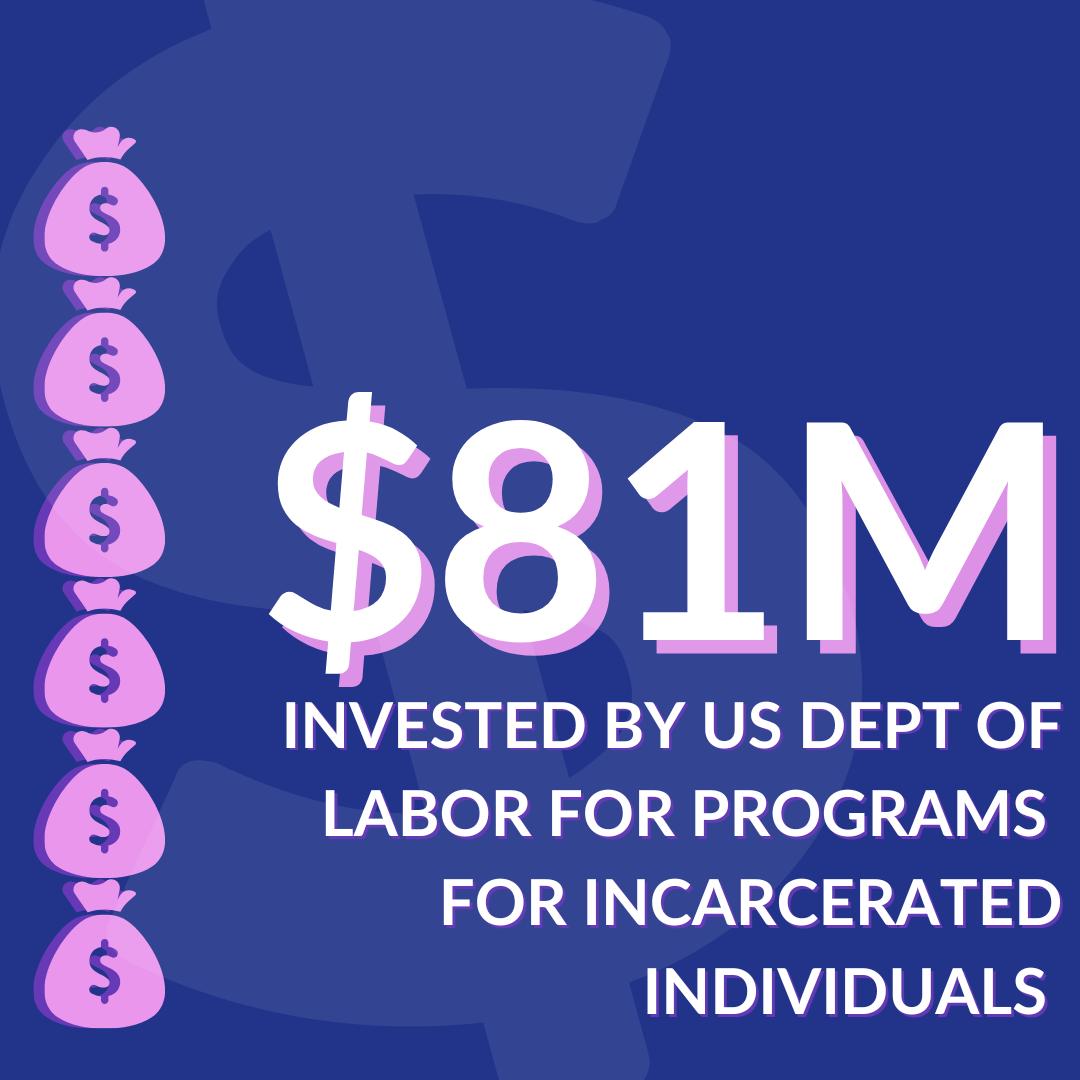
U.S. government invests millions in reentry workforce programs for incarcerated individuals
💡 $81 million in federal grant funding will support individuals reentering society by helping them gain experience and secure employment in skilled trades and high-demand industries.
Source: U.S. Department of Labor – News Release (Feb 25, 2026)
KNOWLEDGE
What to read, watch, and listen
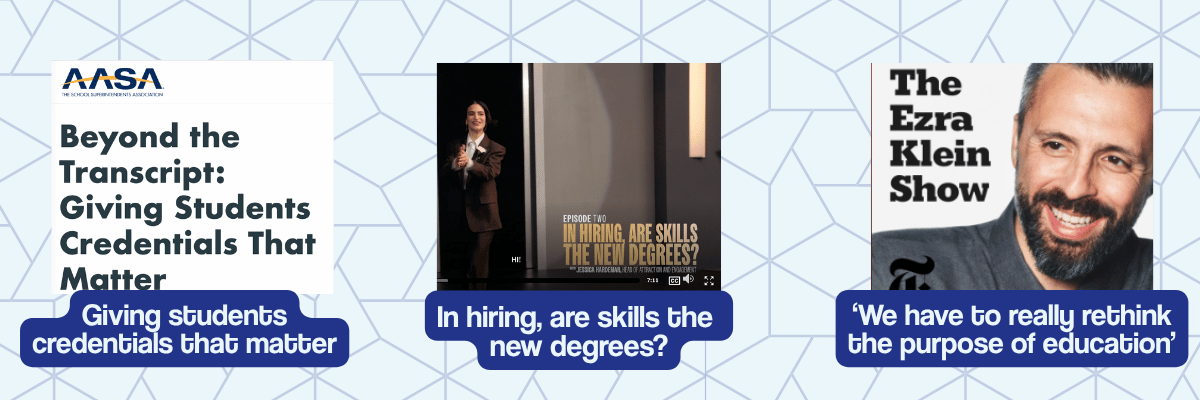
📚 Read: Beyond the Transcript: Giving Students Credentials That Matter by AASA
If you’ve ever thought “the transcript isn’t telling the full story,” this piece goes there. It explores how schools are rethinking what counts and how students can show what they actually know and can do beyond grades.
📺 Watch: In Hiring, Are Skills the New Degrees? by Indeed for The New York Times
We keep hearing that skills are replacing degrees, but what does that shift actually look like in practice? This video takes a closer look at how employers are starting to rethink hiring, and what’s still getting in the way.
🎧 Listen: We Have to Really Rethink the Purpose of Education from The Ezra Klein Show
A bigger-picture conversation on what education is for in a world where skills, AI, and career paths are all shifting at once. It’s the kind of episode that makes you pause and reconsider the foundation of education we’ve all been previously sold.
FOR FUN’SIES

The best HR advice comes from people who’ve been in the trenches.
That’s what this newsletter delivers.
I Hate it Here is your insider’s guide to surviving and thriving in HR, from someone who’s been there. It’s not about theory or buzzwords — it’s about practical, real-world advice for navigating everything from tricky managers to messy policies.
Every newsletter is written by Hebba Youssef — a Chief People Officer who’s seen it all and is here to share what actually works (and what doesn’t). We’re talking real talk, real strategies, and real support — all with a side of humor to keep you sane.
Because HR shouldn’t feel like a thankless job. And you shouldn’t feel alone in it.
💌 Have more feedback? Reply to this email and tell us. We read each one.
🗣️ Want to be featured as a contributor? We’re looking for industry experts to write editorials.
😬 Got a correction or a “well actually”? Send it our way: [email protected].